
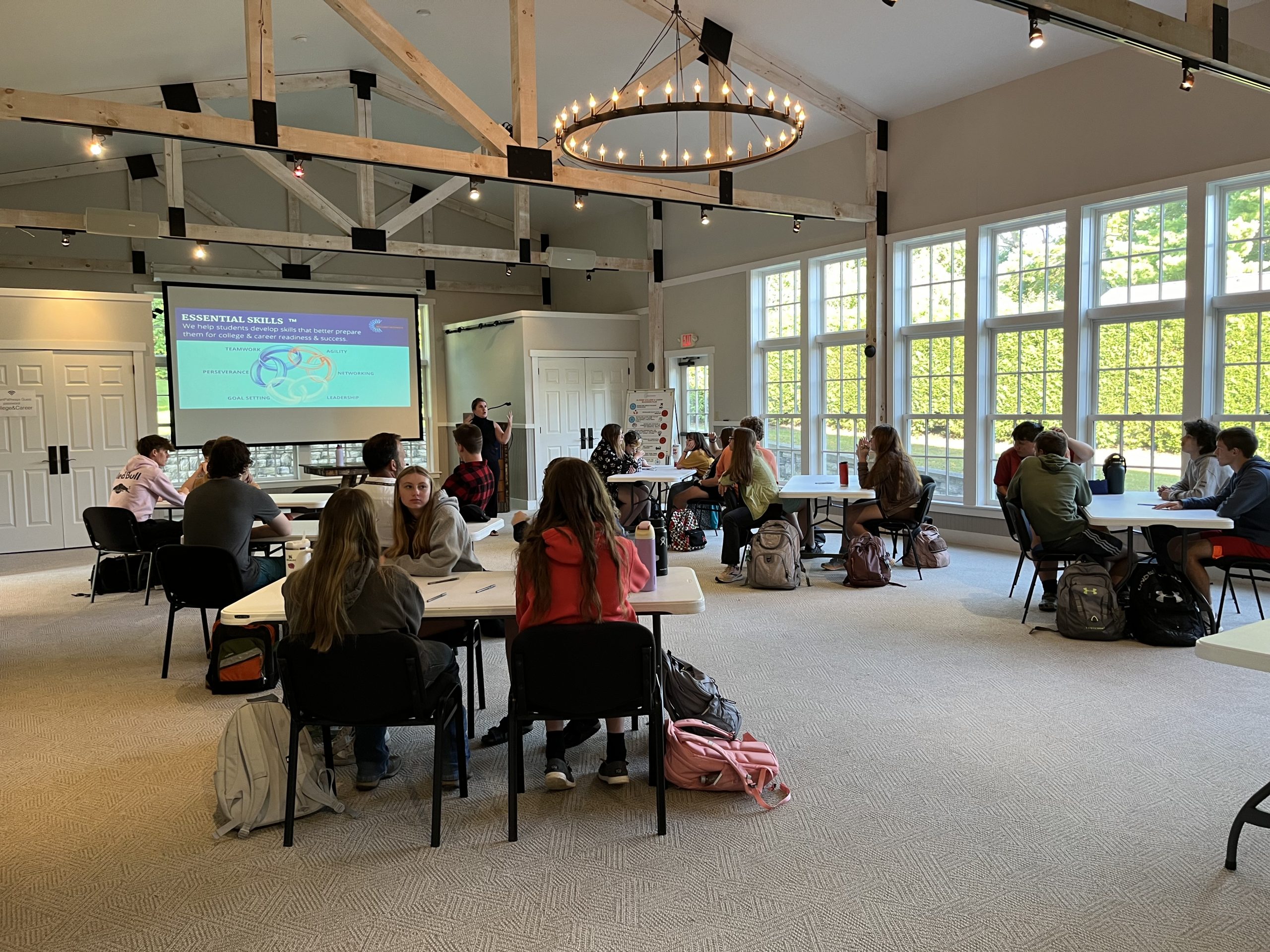
Inspiring teenagers early in the morning can be a real challenge, especially when the topic of discussion is the distant future—college and careers.
This was certainly the case on a recent Friday morning, as a group of sophomores from Boquet Valley High School in Elizabethtown, New York gathered at the nearby CFES Brilliant Pathways headquarters in Essex, NY. As they faced questions about their future, the students responded mostly with silence and murmurs. But things changed when Hannah Corkery, Director of College Success & Career Readiness, posed a thought-provoking question: “Would you rather be 11 feet tall or three inches tall?”
Suddenly, the room came alive. Twenty pairs of eyes snapped open and students began animatedly discussing their answers around their tables.
Without realizing it, they were already practicing some of the Essential Skills that CFES identifies as key to college and career readiness—goal setting, teamwork, leadership, agility, perseverance, and networking. These skills, though not always immediately recognized, would become even clearer as the morning progressed.
Essential Skills are the building blocks of a successful career. Often referred to as “soft skills,” abilities like networking, adaptability, and teamwork are becoming increasingly critical, especially as artificial intelligence takes over many technical tasks like coding, analysis, and computation.
During the session, the Boquet Valley students participated in activities that brought these skills to life. In one exercise, Hannah distributed construction paper, scissors, and tape and tasked each group with making the longest paper chain possible in a short time.
When time was up, most groups had chains with only four or five links.
Hannah then gave the students a few minutes to plan and strategize on how they could improve. Leaders naturally emerged, teams were formed, and tasks were delegated. With a clear goal in mind, the students set to work again, and this time, the chains were three times longer.
One student, who admitted that he typically preferred working solo, shared that the activity gave him a new perspective on the importance of leadership and teamwork—skills he realized would be essential in future projects.
The students were also encouraged to think about how these Essential Skills could apply to real-world situations, such as networking to land an internship or using agility and mentoring to manage financial aid challenges.
As for the initial question about height, one table chose three inches, reasoning that “you could go anywhere.” The rest of the groups opted for 11 feet, saying, “because you don’t want to get stomped on.” Regardless of their differing opinions, each group found a way to reach a unified decision. As Hannah pointed out, “You didn’t always agree, but you found a way to work together.”
This session wasn’t just about answering fun hypothetical questions—it was about helping students recognize the skills they’ll need to succeed in the future, one creative exercise at a time.